Three Borders walks that tell a story
There is no better way to get to know a place than by taking a walk through it. Be it a large city, busy market town or tiny hamlet - getting about on foot is the number one way to notice more and learn about the stories anchored in that location. The same theory holds when you get away from us humans and into the wild, stories don’t stop at the speed limit signs. Scotland is often rightly lauded for having wonderful, breath-taking scenery and The Borders is right up there, but it becomes even richer when you uncover the stories hidden behind the views. So in this short blog I present three great hikes you can take in The Scottish Borders, each with a fascinating tale attached.
Links to walks are all from the wonderful walkhighlands.co.uk It is a treasure.
The Cross Border trail - Newcastleton
Newcastleton was a planned, railway village built by the Duke of Buccleuch in the late 18th century and it’s formal, grid style pattern makes it fairly unusual in The Borders. Locals know it as Copshaw Holm (or ‘Copshae’), and there is a great community here in this most isolated of Border settlements. 20 miles from Hawick, 30 from Jedburgh, 40 from Carlisle and all along small roads - it’s this sense of remoteness and wild country that makes this the perfect place to dive into the history of Border Reivers. One of the finest tales from this lawless time comes from the Tourneyholm, which is visible on this hike. The notorious Wille ‘Kinmont’ Armstrong was seized by troops from Carlisle Castle on a so called truce day when reiving families would have a day off from stealing from each other and meet at the Tourneyholm, a large field by the Liddel Water. Taking a prisoner on a truce day was considered a big no no so even Armstrong’s ‘frenemies’ were not happy about this. Chief among them was Walter Scott of Branxholm AKA Lord Buccleuch. He wrote to Edinburgh and the English ambassador to petition for Armstrong’s removal from the great fortress at Carlisle (across what was an international frontier at this time). Nothing doing. So, along with a small band of kinsmen and other reiving families, crucially including the Grahams who were familiar with the territory, he waded the Eden Water and broke Kinmont Willie out of Carlisle Castle. Anyone who has been to the city knows that castle is no joke, so there was help from the inside but nobody was killed and the perhaps somewhat bemused Armstrong was put on the back of a horse and dropped off back at his house! I think this tale tells us a lot about the Reviers - these were not nice people, but there was some code of honour at play here.
Buccleuch ended up being summoned before Queen Elizabeth of England herself for what was seen as a great insult to the realm. Upon being asked how dare he do such a thing on her soil, Buccleuch is reported to have replied “What is it that a man dare not do?”. Elizabeth wasn’t used to this sort of response, but was impressed by his daring and sent him on his way. From that moment on, history recalls Walter Scott, First Lord of Buccleuch as ‘The Bold Buccleuch’. You will pass the Tourneyholm on this lovely walk, which does indeed cross into England, now our sister and ally, but in 1593 when the bold Buccleuch made his daring raid, very much a foreign nation…
Cross Border Trail, Newcastleton
Twin Law Cairns and Two Tragic Brothers
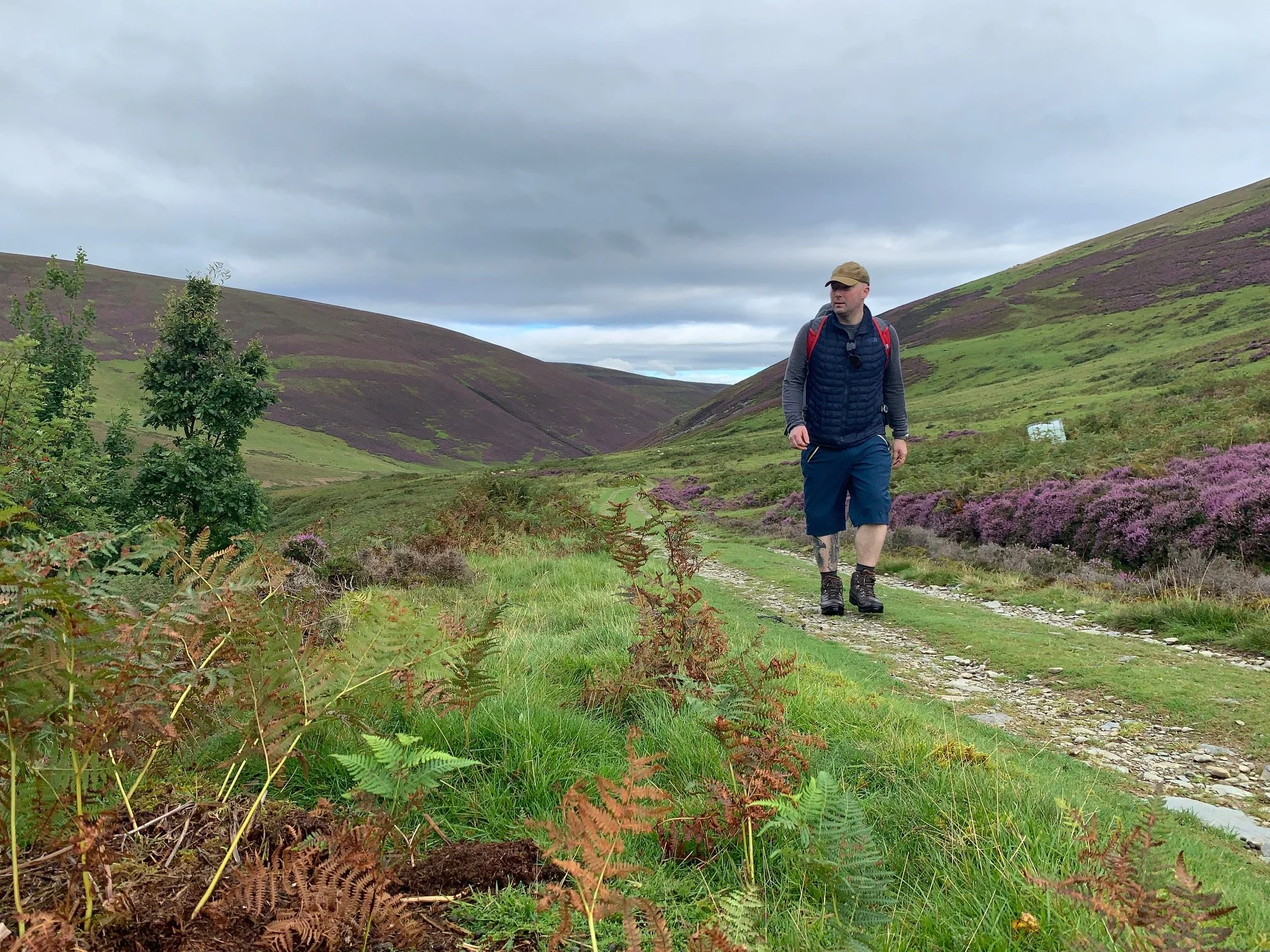
The Lammermuir Hills form part of the northern edge of the Southern Uplands, a natural barrier between Berwickshire and the Lothians. Flat, rounded high moorland criss-crossed with ancient tracks, dotted with heather and the odd haunting story. Chiefly among them is the legend of Twin Law Cairns. These two massive cairns are said to commemorate twin brothers, one fighting for the Scots, the other for the Anglians. They unknowingly fought each other and died here on this spot, or so the legend goes. It’s another reminder of the interesting past of this corner of modern Scotland, which was once a very different, Northumbrian ‘English’ kingdom. Don’t tell the locals in pubs in Gifford or Duns today that they are English, as it’s been Scotland for 1,000 years, but these wrinkles in our history for me make the place richer. The cairns both have seats built into them and are truly massive - a wonderful landmark for miles around.
The Walk Highlands route is fairly straightforward, starting at Watch Water reservoir and following well worn tracks, including the Southern Upland Way for a while, but do keep your wits about you if the clag comes in as these hills can be difficult to navigate in mist.
Twin Law cairns, from Watch Water
The Minch Moor Road and The Great Montrose
This fine circuit out of Traquair takes you on to the historic Minchmoor Road, one of the oldest hill tracks in the country. You’ll pass the enigmatic Cheese Well, where an offering should be left for the wee folk, before a fine section along the old track and climb to the top of the moor. The views here are extensive and well worth the extra effort.
The story here is the escape of James Graham, the Marquis of Montrose - one of the great figures of Scottish history. A man who wrestled deeply with his beliefs before becoming the King’s champion in Scotland, Montrose found himself swept into the brutal conflict known as the War of the Three Kingdoms, the civil wars that tore through Britain and Ireland in the mid 17th century.
In September 1645, his Royalist army was routed by the Covenanters at Philiphaugh, just outside Selkirk. Montrose and a small band of cavalry fled across the old Minchmoor Road, the very track this hike follows. He would survive to fight again, but the man who had been Scotland’s finest military campaigner was arguably never quite the same.
Legend says that Montrose’s gold was lost somewhere along this road during the frantic escape, and perhaps its still lying out there in the heather and bogs! On reaching Traquair, he sought sanctuary and was reportedly turned away. His fortunes continued to decline with betrayal, capture and finally a grim and inhuman execution on Edinburgh’s High Street. Only after the Restoration of the monarchy was his reputation restored, his remains placed with honour in St Giles, the High Kirk of Scotland.
Walking this route today is a chance to reflect on the horror of civil war, be thankful for the freedoms we have and to hope that Scotland never again faces such division.