Why Every Trip to Scotland Should include the Borders
The area of south east Scotland known as The Scottish Borders is a key and essential part of Scotland’s story. It was here that our main language first took hold, our early statehood was asserted and where we, quite literally, collided with our neighbours to the south to form the long island of Britain, hundreds of millions of years ago. For the blink of an eye, or 1,000 years, we have been a proud part of the nation of Scotland and have developed a distinct culture and voice within our country. After the decline of a once mighty woollen textile industry, it is clear that tapping into our value as a destination for tourists and enhancing the visitor economy is a priority. Yet there is much work to be done. Our value as a ‘brand’ does not resonate as well with international or domestic visitors, certainly in comparison to established visitor areas such as Edinburgh, The Highlands, Fife and Stirling. Indeed, visitor spend in The Scottish Borders area lags behind all of these areas, plus every other mainland market in Scotland, as defined by Visit Scotland. The devil is in the detail of course, and we have a small population compared to these areas, but it clearly shows room for growth in our visitor economy.
total spend by international and domestic visitors in 2024 (millions)
It has been clear to me in my years as a tour guide that a vision of Scotland exists that is defined by travel to Edinburgh, exploring our capital then heading on a roughly defined circular loop which takes in locations such as Loch Lomond, Glen Coe, Glenfinnan, Skye, parts of the NC500 route, Loch Ness, Inverness, St. Andrews and Stirling. This is not new information - these have always been regarded as exceptional visitor attractions and with good reason (though personally I find the most impressive thing about Loch Ness is what you can’t see - and I mean its depth, not the monster!) Anecdotally these locations are becoming busier, with the rise of platforms such as Instagram and Tik Tok surely helping promote them to the world and adding to the idea of Scotland as a distinct, must-visit location. However, I believe that those who only choose to visit these locations miss out on much of the richness of the country, which goes beyond many of the stereotypes associated with Scotland. Clearly all areas of Scotland have their story and we should encourage visitors to explore widely. My focus is the Scottish Borders and the fact that it shows the lowest mainland spend of all Visit Scotland’s regions is evidence enough for me to focus on promoting it in this piece.
I suggest that a visit to Scotland should include The Scottish Borders as part of a fully balanced itinerary, as the area offers a sense of calm, great historical weight, authentic community life and an innovative approach to telling Scotland’s story, reshaping how our country is understood.
The idea of calm, linked to slow travel and wellness is something we should encourage in The Borders. I don’t think this area can ever expect to challenge more traditional tourist hotspots for the numbers shown in the graph above, but from my experience I think even a doubling of current visitor levels would still leave the calmness of the area as a significant draw. Think quieter attractions with no long lines to get in, quaint towns where you can grab food on the spur of the moment and open space on rolling hills and secluded estates. Innovative approaches such as Pilates and wellness retreats at Kailzie Estate, near Peebles, or the Harvest Wild Swim Festival on the River Tweed are exactly what I feel we should be leaning into as an area - come to The Borders to find a slower pace where you can absorb Scotland, not chase it.
Many of my tour guests who come to The Borders end up being surprised by the sheer depth of historical sites and stories concentrated in the area. This is Scotland in microcosm, thousands of years of human activity, from the prehistoric to the present day, but I would argue The Borders plays a key part in our history, and that role is desperately misunderstood or, perhaps even worse, ignored. Long before the nation of Scotland was a concept, tribal celts spoke dialects of Old Welsh here and created a culture which was shocked to the core by the arrival of Roman invaders. Later, as an Anglian stronghold, the English and Scots languages took root here, along with the light of the church brought by holy men such as Saints Boisil and Cuthbert. It was here, by the River Tweed where a line was drawn 1,000 years ago to mark the division between the Angles/English and the territorial expansion of the Scots. A century later, King David I made our area the very heart of his Kingdom of The Scots with several towns formed, a royal castle and mint, and perhaps most famously of all four great abbeys populated by reforming monks who developed a culture, agricultural economy and civilisation which echoes to the current day. Scotland’s oldest inhabited house, Traquair, is here, offering a view into the past unsurpassed in the country. Our greatest port was also once here, but the Anglo-Scottish wars meant Berwick was lost, and the Borders slid to the peripheries of Scotland, becoming a dangerous, near lawless zone with the rise of Border Reivers. It is tempting to say that that move to the edge of the national consciousness in the 15th century has never fully been undone, even after the unions of, firstly the crown, then parliament brought peace here. The Borders however is resilient and the seeds of agrarian industry planted by the Monks of Kelso and Melrose lead to a new golden age for the region, as mechanical production of consumer products in wool coupled with access to technology, fuel and a skilled workforce led to a 19th century boom in the region. The combined shocks of the 20th century meant the loss of much of this high quality, international industry and further setbacks have followed, but The Borders has never lost its identity and spirit, or its ability to innovate. In our history and stories, we represent a key part of Scotland, and this deserves to be told.
To visit the Border towns is to experience the wonder of local community and strong, regional identity. None of this is unique to the area, but it is arguable that in an increasingly homogenous world and in a nation which increasingly presents a ‘one size fits all’ version of itself to the world, then this Border identity we have is more important than ever. These are the towns where a man from Jedburgh has a markedly different accent to a man from neighbouring Hawick. A place where medieval traditions of horsemanship and ‘aye defending’ your rights and common land still means something deep in the soul. Where Rugby Union and its values are played and practiced. A place where tweed is both a river and a badge of regional and sartorial honour. The Borders is the home of myths and legends, or mysterious lonely valleys where perhaps the fairy folk still live, where redcaps are waiting for you or hares dance around stone circles in the pale moonlight. This isn’t to present The Borders as some sort of cryptozoology hotspot - Loch Ness-lite if you will, but these tales are deeply ingrained in the area. Many were collected (or perhaps invented…) by locals such as Sir Walter Scott, James Hogg or John Buchan. They offer fireside fodder for storytelling and helping to nurture the flame of a distinctly Borders culture which appeals to visitors while maintaining a legacy which is authentically ours and was built from the challenges of the past. In The Borders you will find a warm welcome from people who are proud, and sure of their local identity.
Innovation has driven The Borders for centuries, and now in the 21st century it is clear that to try and compete (with significant competition) for visitors this needs to be accelerated, or we will fall behind. Local attractions such as The Great Tapestry of Scotland are at the forefront of this. A visit here is essential and for those at the start of a Scottish trip it is the perfect place to learn about the people, places and stories they will meet as they explore the country. As well as offering a first-rate visitor experience through the layered stories the tapestry tells, they also excel at collaboration such as hosting a year-long programme of art, history and storytelling experiences and workshops entitled Two Nations: Two Tapestries to mark the once in a generation loan of the Bayeux Tapestry to the UK.
Looking at ways to utilise transport links, the crucial travel trade market and digital interpretation are vital for forward thinking attractions such as the Tapestry, Sir Walter Scott’s Abbotsford and The Trimontium Museum in Melrose. Cross-agency collaboration can help our attractions find new audiences, and utilising technology can help show what we have lost as well as what remains - imagine drones with lights to show the scale of Kelso Abbey as it celebrates its 900th year or government support for permanent uncovering of vast Roman remains at Trimontium fort, twice the size of any found on Hadrian’s Wall. A new Housesteads (80,000 annual visitors) in Newstead?!?
Innovation must not just be restricted to our heritage however. A focus on high quality Scottish products through forward thinking businesses such as Mainstreet Trading in St. Boswells, Scotland Shop in Duns, Cashmere and Weaving mills in Hawick & Selkirk, Tempest Brewery in Tweedbank or Borders based online retailer madescotland.com is how we should look to present the Borders to the world, and encourage them to take a piece home with them. To be frank, let’s make it a ‘tartan tat’ free zone!
Events are vital to the visitor economy, with the region having a proven track record of delivering top class cycling events for example. Developing this side of The Borders, both in terms of large events themselves but, crucially, legacy is important. How, for example, will the huge market of cycle tourists from across Europe be signposted to ride the Tour De France Grand Depart route after it makes its way through The Borders in 2027. Only by having the boldness to grab events such as this and the foresight to ensure a legacy will the Borders help reach its visitor potential.
As you enter Scotland on the M74 from the West at Gretna Services you are presented with a Scotland Shop offering tartan, Nessie, AI generated images of hairy coos and shortbread tins. In the East, on the A1, you pass three great flagpoles, all carrying the St Andrews Cross, as decreed by the Scottish Government, with nothing to suggest you have entered the ancient county of Berwickshire, a key part of the Scottish Borders. This blog has attempted to persuade those driving to Scotland that instead of carrying straight on at these crossing points, visitors who head right or left respectively will find a place where the regional identify and culture is both a part of, and apart from, that of Scotland you are traditionally presented with. A place where calm, great history, strong regional identity and innovation can all be found. My suggestion is that visitors become a part of our story by adding the Scottish Borders to their Scotland itinerary. And for those flying into Edinburgh and making for the loop to the North, factor in a day (or three) where you explore what lies south of the capital - Scotland’s missing chapter. Come today, thank us tomorrow.
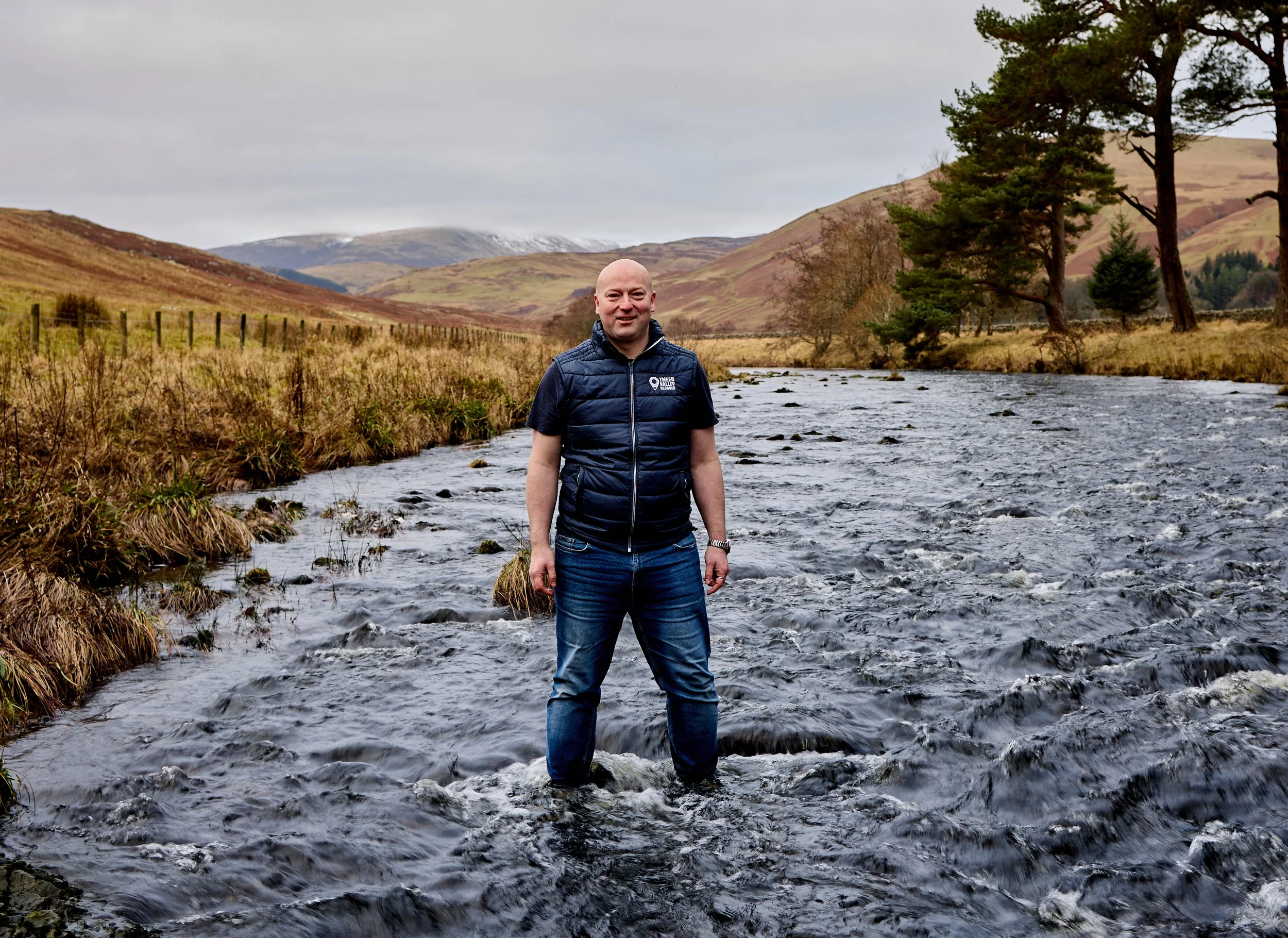
Stewart Wilson is a Tour Guide and Blogger, passionate about connecting people with place. Find out more about his work on tweedvalleyblogger.com
Stewart lives and works in The Scottish Borders.